Prices incl. VAT plus shipping costs
Ready to ship. Delivery time appr. 2-4 workdays
- Order number: 4004320
- Originalnummer: 311 415 511 B
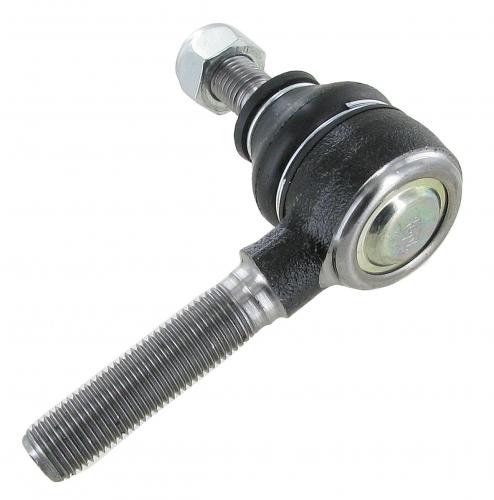
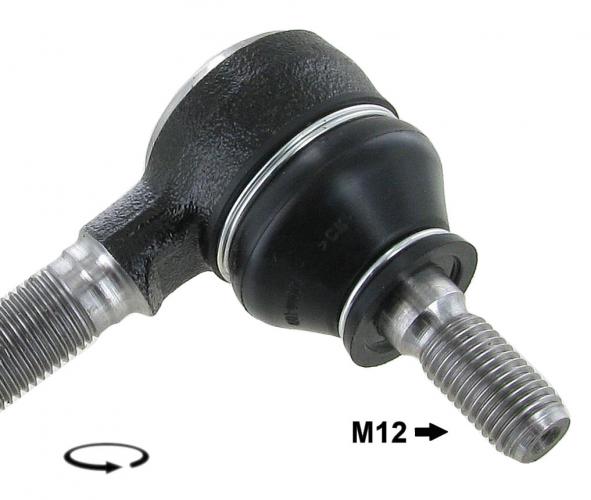
Tie rod end with left-hand thread, premium quality.
M12.
VW Beetle - from 1968 onwards.
Karmann Ghia - from 1968 onwards.
T2 Bus - 8/67 to 7/79.
VW Type 3 - from 8/67 onwards.
VW 181 (Thing).
A worn steering ball joint or tie rod ball joint can be recognised by excessive play, which on most vehicles is only noticed at inspection. With a worn protective boot it may be enough to replace the rubber, but it is not advisable to do so. During the time the rubber was damaged, dirt got in, mixed with the grease in the ball joint and led to wear. You will probably have to replace the ball joint at the next inspection, but bear in mind that you have already been driving for some time with a worn ball joint, which does not increase safety. A new tie rod end is not a big investment. On some ball joints you can choose between an A-quality that matches the original and a B-quality. The B-quality is certainly not a bad choice, but you have to compromise on service life.
To make it easier to identify the ball joint, the text states whether it has a left- or right-hand thread and how large the thread on the ball pin is. The tie rods are supplied with a self-locking nut or a castle nut with cotter pin (see image). A castle nut can be replaced with a self-locking nut; the reverse is not possible.
Types of steering boxes:
On the old models of the Volkswagen Beetle and Karmann Ghia we refer to the worm and sector steering, which was later replaced with a worm and roller steering. On the Beetle 1303 and T25/T3 Bus a rack-and-pinion steering was used. It is important to know what is fitted under your car; here is the full explanation:
Volkswagen used the worm and sector steering on the Volkswagen Beetle up to 1965 and on the Karmann Ghia up to 1961. The steering box consists of a fork (sector) with a gear that turns on a shaft (worm) to enable the rotary movement. In the later years a worm and roller steering was used, where too only the toothed sector was replaced with a support roller (worm gear). From 1974 the Beetle 1303, like the third-generation buses (Vanagon T25/T3), was fitted with a rack-and-pinion steering. This is a rectangular bar with teeth on one side like a gear. With the pinion, a small gear that engages the teeth, the bar can be moved lengthwise. Volkswagen did not implement this change on all models at the same time, so the following list shows when and on which VW model the system was used.
Worm and sector steering:
Beetle export model up to 1961 (chassis no. 3 933 184)
Beetle Convertible up to 1961 (chassis no. 3 933 184)
Beetle for the domestic market (standard version) up to 7/1965
Karmann Ghia up to 1961 (chassis no. 3 933 184)
Worm and roller steering:
Beetle export model from 1961 (chassis no. 3 933 185) onwards
Beetle Convertible from 1961 (chassis no. 3 933 185) to 7/1974
Beetle 1200, 1300, 1500 from 8/1965 onwards
Beetle 1302 and 1303 up to 7/1974
Karmann Ghia from 1961 (chassis no. 3 933 185) onwards
VW Bus up to 7/1979
Type 3 all models and years
VW Type 181 (Thing) all models and years
Rack-and-pinion steering:
Beetle 1303 from 8/1974 onwards
Hersteller:
Moog (DRiV)
Prins Boudewijnlaan 5
48147, Kontich
Belgium
info@driv.com